

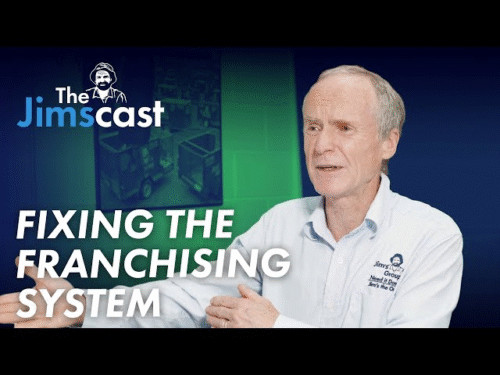
Franchising has long been sold as a path to business ownership, offering a ready-made model and the backing of a recognizable brand.
But after decades of being in this space, I can tell you that the system is broken, primarily because of a massive imbalance of power between franchisors and franchisees.
The Core Problem: Too Much Power in the Wrong Hands
The fundamental issue, as I see it, is that franchisors hold too much power.
Contracts are written to favor them, often leaving franchisees with little protection.
In many systems, franchisors can change the rules without consultation, demanding expensive store refurbishments or enforcing product pricing that cuts into margins.
It’s not fair, and it’s not sustainable.
In my own system at Jim’s Group, I made a different choice.
I gave franchisees veto power over changes to their manuals.
If we propose a change, we go directly to the people it affects and ask, “What do you think?”
Most of the time, if it makes sense, they agree.
But they have the right to say no—and that keeps us accountable.

The Dangers of Public Ownership
One trend that alarms me is the shift from private ownership to publicly listed franchise groups.
When outside investors take over, the focus turns to short-term profits.
The business gets stripped for cash, and the franchisees suffer.
We’ve seen what happened with Retail Food Group.
The damage was enormous, and it all came down to forgetting the most important truth in franchising: your success depends on your franchisees’ success.
If they fail, the system crumbles.
That’s why I believe the government must step in.
Franchisee protections need to be written into law.
It shouldn’t be up to individual franchisors to decide whether they want to treat their franchisees fairly—it should be mandatory.
A Transparent System That Works
One solution I strongly support is a government-run, transparent survey system.
Every franchisee in every system should be surveyed confidentially, once a year.
The results should be made public.
That kind of transparency would put enormous pressure on franchisors to treat people well, or risk being exposed.
We already do this at Jim’s Group.
We survey our franchisees every year, and the results drive awards, improvements, and accountability.
If your franchisees are happy, you’ve got nothing to fear.
If they’re not, you’d better fix it.

Simplifying the Legal Minefield
Franchise agreements today are ridiculous.
I’ve seen legal documents so dense that even lawyers struggle to understand them.
When I created my own franchise contract, I sat down and wrote it in plain English.
I wanted something clear, short, and fair.
Of course, my lawyers pushed back.
They said some parts were too simple.
But I held my ground.
The goal wasn’t to create a trap—it was to create a partnership.
Franchisees deserve to understand what they’re signing.
Empowering Franchisees With Real Choice
One of my core beliefs is that franchisees should have real autonomy. That includes:
- The right to veto changes to operations manuals
- Fair and automatic contract renewals
- Protection against forced supplier arrangements or unfair costs
- And most importantly, the right to walk away and go independent
If someone no longer wants to be Jim’s Mowing or Pizza Hut, they should be able to take down the sign, rename the business, and keep working.
They shouldn’t lose their lease or be crushed by legal threats.
That freedom keeps franchisors honest.
If I know someone can leave at any time, I’m going to do everything I can to keep them happy and successful.

Reinventing Dispute Resolution
The legal system isn’t built for franchisees.
Court battles are expensive and time-consuming.
So I propose something different: a private, transparent mediation system—what I call “eBay justice.”
Here’s how it would work: a publicly reviewed pool of mediators would be available for both sides to choose from.
After each case, both parties leave a rating.
If a mediator favors big corporations too often, nobody will use them.
The best judges rise to the top based on reputation, not wealth or connections.
It’s fast, fair, and puts pressure on everyone to act with integrity.
What I Know for Sure
If we give franchisees real power, everything changes.
Franchises get better.
Franchisors have to compete based on merit, not manipulation.
Prospective franchisees will know where they stand before signing up.
That’s the kind of system I’ve built at Jim’s Group.
It’s not perfect, but it works—because it’s based on respect, fairness, and results.